A White-fronted Goose caught at Tyulenovo last January was found in Hungary
25.11.2011
Last January a joint WWT and BSPB team made the first successful goose catch in Bulgaria using canon nets. One of the Greater White-fronted Geese (
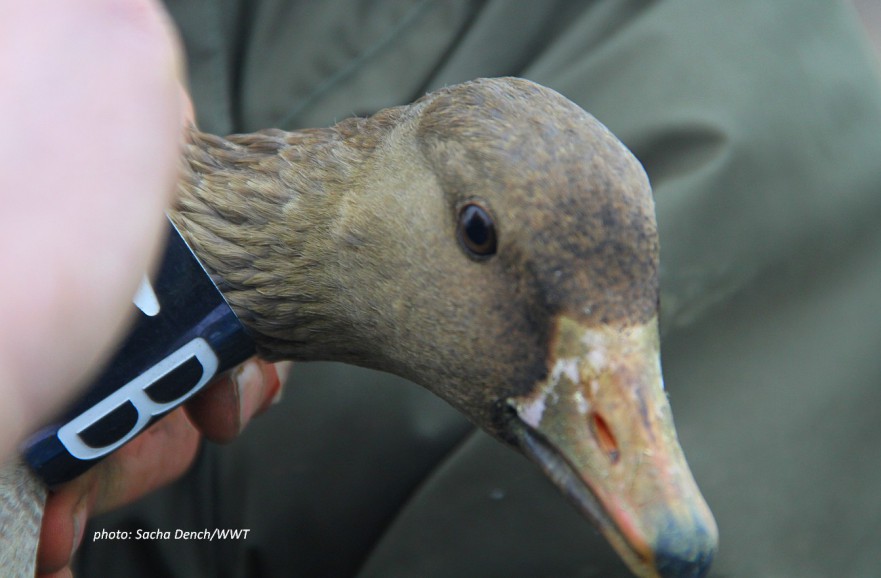
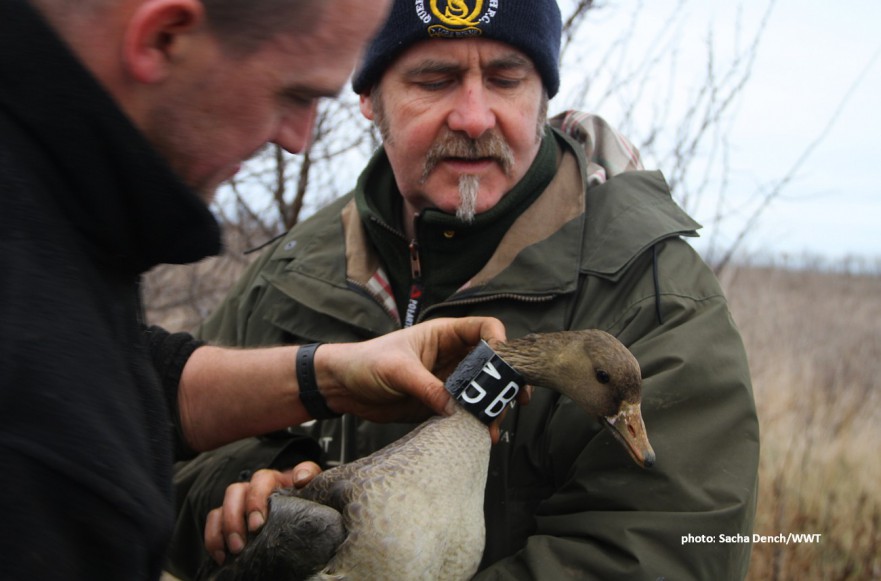
Anser albifrons) that were caught in the fields near the village of Tyulenovo, was found this November in Hungary. The goose with a neck band with the letter code “BAB” was observed on 15
th November 2011 in the Tomorkeny part of the wetland complex “Nagy Seg To Csaj-to”, in the Csongrad region on Hungary (southeastern part). The goose was a young female caught by the project field team and neck-banded as part of the research activities of the LIFE Project “Sve Grounds for the Redbreasts” and the cooperation with the Pan-European White-fronted Goose marking project coordinated by our German colleague Helmut Krukenberg. The bird was registered by a local birder – Csaba Barkoczi. This observation is the first recovery of any of the marked geese since last winter and shows that the bird has managed to survive the perilous flight through the spring hunting zones in Russia and Kazakhstan back to its breeding grounds in Arctic Russia.
The finding of the goose in Hungary is interesting in many ways. First of all it suggests that the bird might have flown to a new wintering area this season – in Hungary. It also reveals connectivity between the geese observed in winter in Bulgaria and Hungary. According to the flyway delineation the Whitefronts wintering in Bulgaria belong to the Ponto-Anatolian Flyway population, while the Hungarian goose are assigned to a different one – the Panonic Flyway population. Though it is not rare to have exchange between neighboring populations there is still much speculation about what happens to the Whitefronts and the small flocks of Redbreasts that appear in October and November in high numbers in the Svishtov-Belene lowlands of Bulgaria and disappear in December/January. Though, untill recently it was speculated that these birds move back towards Danube Delta area and Bulgarian Dobrudgea, things might be quite different. This new recovery evokes speculations and suggestions that the Whitefronts might actually be moving further along the Danube River towards Hungary. More over that small flock of Redbreasts is regularly observed wintering in Hungary and those might be the same birds disappearing from the area around Svishtov. A satellite-tagged Whitefront named “Gula”, flew close by last spring passing from Hungary to Danube Delta through Black Sea coast to Kalmikia showing connectivity lines in sring migration. Therefore there might be much more overlap between these two flyway populations than thought before, but we need more recoveries and data to know better how big is the overlap.
We express our sincere thanks to the Bulgarian Ringing Center and Dr. Boris Nikolov for communicating the information to us and his continuous cooperation with the project.


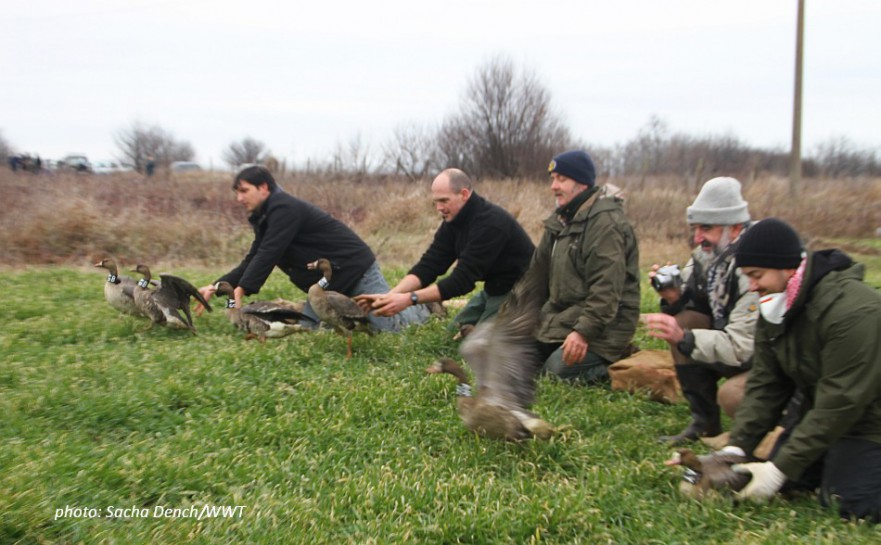 Last January a joint WWT and BSPB team made the first successful goose catch in Bulgaria using canon nets. One of the Greater White-fronted Geese (Anser albifrons) that were caught in the fields near the village of Tyulenovo, was found this November in Hungary. The goose with a neck band with the letter code “BAB” was observed on 15th November 2011 in the Tomorkeny part of the wetland complex “Nagy Seg To Csaj-to”, in the Csongrad region on Hungary (southeastern part). The goose was a young female caught by the project field team and neck-banded as part of the research activities of the LIFE Project “Sve Grounds for the Redbreasts” and the cooperation with the Pan-European White-fronted Goose marking project coordinated by our German colleague Helmut Krukenberg. The bird was registered by a local birder – Csaba Barkoczi. This observation is the first recovery of any of the marked geese since last winter and shows that the bird has managed to survive the perilous flight through the spring hunting zones in Russia and Kazakhstan back to its breeding grounds in Arctic Russia.
The finding of the goose in Hungary is interesting in many ways. First of all it suggests that the bird might have flown to a new wintering area this season – in Hungary. It also reveals connectivity between the geese observed in winter in Bulgaria and Hungary. According to the flyway delineation the Whitefronts wintering in Bulgaria belong to the Ponto-Anatolian Flyway population, while the Hungarian goose are assigned to a different one – the Panonic Flyway population. Though it is not rare to have exchange between neighboring populations there is still much speculation about what happens to the Whitefronts and the small flocks of Redbreasts that appear in October and November in high numbers in the Svishtov-Belene lowlands of Bulgaria and disappear in December/January. Though, untill recently it was speculated that these birds move back towards Danube Delta area and Bulgarian Dobrudgea, things might be quite different. This new recovery evokes speculations and suggestions that the Whitefronts might actually be moving further along the Danube River towards Hungary. More over that small flock of Redbreasts is regularly observed wintering in Hungary and those might be the same birds disappearing from the area around Svishtov. A satellite-tagged Whitefront named “Gula”, flew close by last spring passing from Hungary to Danube Delta through Black Sea coast to Kalmikia showing connectivity lines in sring migration. Therefore there might be much more overlap between these two flyway populations than thought before, but we need more recoveries and data to know better how big is the overlap.
We express our sincere thanks to the Bulgarian Ringing Center and Dr. Boris Nikolov for communicating the information to us and his continuous cooperation with the project.